
Monmouth County has two completely different soils, and the lawn advice that works in one fails in the other.
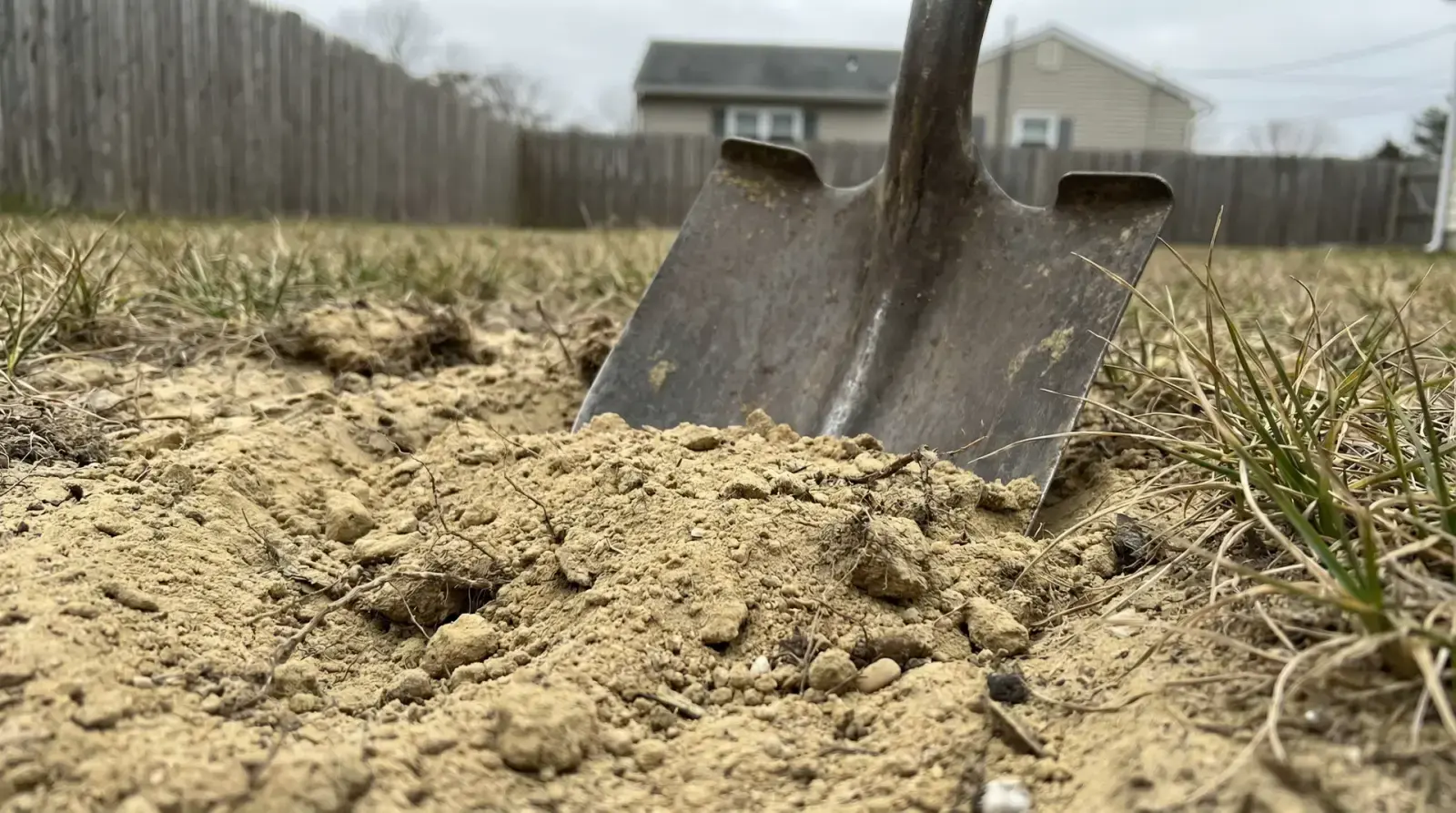
Out toward the water — Sea Girt, Spring Lake, Manasquan, Brielle — the ground is sand. Inland, across Freehold, Howell, Manalapan, Marlboro, and Colts Neck, you are usually on clay. If you have ever dug a hole in your yard and hit dense, sticky, orange-grey soil that holds the shape of the shovel, that is clay, and it changes everything about how you grow grass.
What clay actually does to a lawn
Clay particles are extremely fine and pack tightly together. That produces three problems at once.
Water sits on top. Clay absorbs water slowly. Rain or irrigation puddles on the surface and runs off before it soaks in, so the lawn can be waterlogged and thirsty in the same week.
Roots cannot push through. Compacted clay is physically hard for roots to penetrate. Shallow roots mean a lawn that browns out fast in a dry August despite the soil holding plenty of water lower down.
It compacts easily. Foot traffic, mowers, and kids compress clay further, and each pass makes the first two problems worse. This is why a clay lawn often looks worst exactly where the family actually uses it.
The upside, and it is a genuine one: clay holds nutrients far better than sand. Once you fix the structure, a clay lawn is easier to feed and stays green longer between waterings than a sandy one ever will.
The best grasses for clay soil in New Jersey
The rule for clay is root strength — you want a grass that can drive roots into dense ground and tolerate periodically wet feet.
1. Tall fescue — the best choice for Monmouth clay
Tall fescue is the strongest cool-season grass for clay soil. Its roots are aggressive and deep, reaching six inches or more, and they are capable of working into denser ground than the fine-bladed grasses can manage. That depth is exactly what a clay lawn needs, because it connects the plant to moisture below the compacted surface layer.
It also handles the wet-then-dry swing clay produces. Clay lawns flood in spring and bake hard in August, and tall fescue tolerates both ends of that better than the alternatives.
This is the grass we install across Monmouth County, grown to the Sod Squad Standard. On inland clay it is not a close call.
2. Kentucky bluegrass — good in a blend
Bluegrass tolerates clay reasonably well and brings something tall fescue lacks: it spreads by underground rhizomes and repairs its own damage. On compacted clay, where thin and worn patches are common, that self-repair genuinely matters.
Its roots are shallower, so leaning on it alone in heavy clay leaves you exposed in a drought. As a percentage of a blend, alongside tall fescue, it earns its place.
3. Perennial ryegrass — the establishment helper
Ryegrass germinates fast and takes traffic well, which makes it a useful blend component. It is less drought-tolerant and shorter-lived on its own. A supporting player, not the lawn.
What to skip
Zoysia and Bermuda. Both handle clay, and both are warm-season grasses that go dormant straw-brown from roughly October through May in New Jersey. Seven months of brown is not a solution.
Fine fescue. Often sold for sandy, dry or shaded ground. It is genuinely poor in heavy wet clay. For shade, our tall fescue blend holds under heavy tree cover. This is the grass most often recommended by generic articles that do not know your soil.
Fixing the structure, which matters more than the grass
You cannot change clay into loam, but you can change how it behaves.
Core aeration is the single best thing you can do. A core aerator pulls plugs of soil out of the ground, opening channels for air, water, and roots. On clay lawns this is not optional maintenance — it is the treatment. Once a year, ideally in fall, and twice a year on heavily used lawns.
Add organic matter. Compost worked into the top few inches separates clay particles and creates pore space for water and air. This is the slow, permanent fix, and it compounds every year you do it.
Never work clay when it is wet. Tilling, digging, or driving on saturated clay destroys its structure and creates compaction that takes years to undo. Wait until it is merely damp.
Water deeply and infrequently. Clay absorbs slowly, so long slow soaks beat short frequent ones. If water starts running off, stop, let it soak in, and come back — the cycle-and-soak method.
Skip the sand. Adding sand to clay is common advice and it is wrong. In the wrong proportions sand plus clay is closer to concrete than to soil. Organic matter is the answer; sand is not.
Why we amend the soil before laying sod
Sod laid directly onto compacted clay roots poorly. The roots hit a dense layer, stall at the interface, and the lawn sits there looking fine for a month before thinning out in its first real summer.
We amend the base before installing for exactly that reason. We grow our own soil, and on Monmouth clay the soil work is the part that decides whether the lawn is still strong in year three. It is also the part most often skipped, because it is invisible the day the job finishes.
Sod itself helps too. It arrives with about nine months of growth and an established root system behind it, so it is not trying to germinate on a surface that alternately puddles and bakes — which is the reason so many seeded clay lawns come in patchy.
The bottom line
- Best grass for Monmouth clay: tall fescue, for root depth and wet-dry tolerance.
- What we install: a tall fescue blend.
- Skip: zoysia, Bermuda, and fine fescue.
- Do not skip: core aeration and organic matter. Grass choice alone will not fix clay.
If your inland Monmouth lawn puddles in spring and goes crispy in August, that is not a watering mistake. That is clay, and it is fixable.