
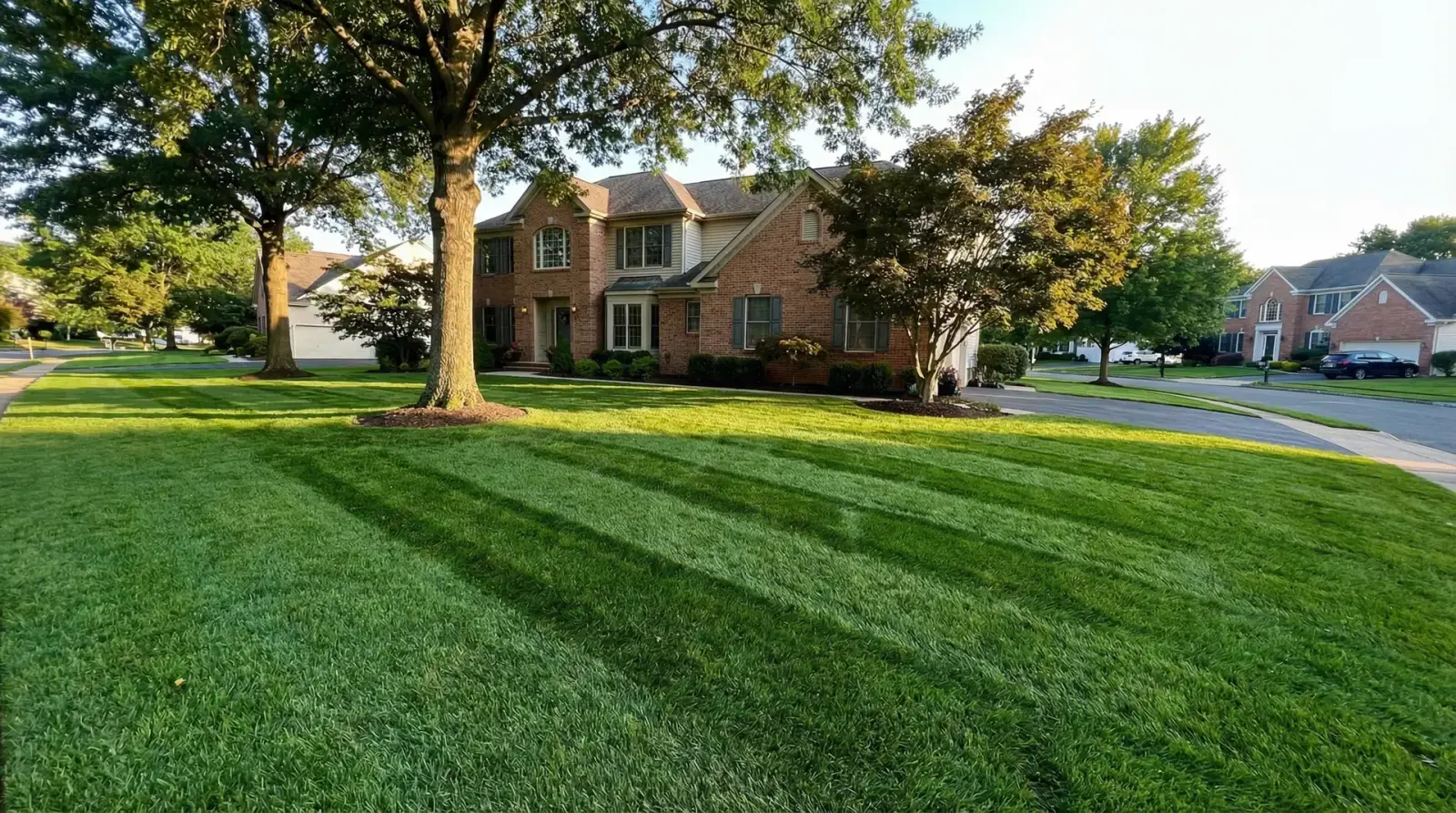
Full sun sounds like the easy case. It usually is — but the lawns that fail in full sun fail for a reason nobody warned them about, and inland Monmouth County has a lot of full-sun yards.
Newer developments across Freehold, Howell, Manalapan, and Marlboro were built on cleared farmland. Open lots, few mature trees, and nothing between the grass and the sky from sunrise to sunset. That is genuinely good growing conditions — right up until late July.
What full sun really means
Six or more hours of direct sunlight a day. Most open Monmouth lots get eight to ten.
The problem is not the light. Grass wants light. The problem is what comes with it: soil surface temperatures well above air temperature, rapid evaporation, and heat stress on cool-season grasses that genuinely prefer 60 to 75 degrees. Our grasses do their real growing in spring and fall. July and August are the months they endure.
So choosing a full-sun grass in New Jersey is not about finding one that likes sun. It is about finding one that can hold on through the heat without going backwards.
The best grasses for full sun in New Jersey
1. Tall fescue — the most heat and drought tolerant cool-season grass
Tall fescue is the best choice for a full-sun New Jersey lawn, and the reason is underground. Its roots run six inches deep and often deeper, which lets it reach moisture well below the layer that bakes dry in a heat wave. Where shallow-rooted grasses go dormant and brown in a dry August, tall fescue is usually still pulling water.
It also has the highest heat tolerance of the cool-season grasses. That does not mean it loves August — nothing cool-season does — but it means it comes out the other side without needing to be renovated.
This is the grass we install, and open full-sun lots are one of the clearest cases for it.
2. Kentucky bluegrass — the best-looking, if you can water it
There is a reason bluegrass is the classic American lawn. Dense, fine-bladed, deep blue-green, and it repairs its own wear through spreading rhizomes. In full sun with adequate water, nothing looks better.
The condition is the water. Bluegrass has shallower roots and higher water demand, and in a hot dry Monmouth August without irrigation it goes dormant and brown early. It is a genuinely great full-sun grass if you have a sprinkler system and will run it.
3. A tall fescue blend — what most people should install
For most open sunny lots, a tall fescue blend is the answer. It is the one grass we install. It carries the heat and drought load and keeps a deep green color.
4. Perennial ryegrass — the fast component
Germinates quickly and takes traffic, which makes it useful in blends. Less heat-tolerant on its own and shorter-lived. A component, not the lawn.
What to skip
Zoysia and Bermuda. Both genuinely thrive in full sun and heat — in the South. In New Jersey they go dormant straw-brown from roughly October through May. Green in August, brown for the other seven months.
Managing a full-sun lawn through a Jersey August
Grass choice gets you most of the way. These four habits get you the rest.
Mow high. This is the big one. Three and a half to four inches. Taller blades shade the soil surface, cutting evaporation and keeping root-zone temperature down, and a taller plant supports deeper roots. Scalping a full-sun lawn in July is the single most common way people destroy it. If you change one thing, change this.
Water deeply and infrequently. About an inch per week, delivered in one or two long soaks rather than daily sprinkles. Frequent shallow watering trains roots to stay near the surface, which is precisely the wrong outcome in a lawn that needs depth to survive heat.
Water early. Between 4 and 9 in the morning. Midday watering loses a lot to evaporation; evening watering leaves the blades wet overnight and invites fungus.
Do not feed heavily in summer. Pushing nitrogen onto a heat-stressed cool-season lawn forces tender growth exactly when the plant is least able to support it. Feed in fall and spring; leave it alone in July and August.
Where irrigation genuinely pays for itself
On a shaded or mixed lot, a sprinkler system is a convenience. On an open full-sun lot in inland Monmouth, it is closer to infrastructure.
An eight-to-ten-hour sun exposure with no tree cover and a dry stretch in August will take a lawn backwards in a week or two of neglect. Hand-watering an open lot properly means moving a sprinkler around for hours at a time on a schedule most people cannot keep through a working summer.
This is why so many of our full-sun installs go in alongside irrigation. Not as an upsell — because the two decisions are linked, and it is cheaper to do the irrigation before the lawn is down than to trench through a finished one later.
The bottom line
- Best full-sun grass for NJ: tall fescue — deepest roots, best heat and drought tolerance.
- What we install: a tall fescue blend.
- Skip: zoysia and Bermuda — brown for over half our year.
- The habit that matters most: mow at 3.5 to 4 inches. It outperforms most products.
Open sunny lots are the easiest lawns in Monmouth County for nine months and the hardest for three. Pick for the three.