Quick answer
What is the best topsoil for lawns? Screened loam: roughly 40% sand, 40% silt and 20% clay, with 5 to 10% organic matter. It holds water without staying soggy, holds nutrients, and stays loose enough for roots. Avoid "topsoil" that is really screened subsoil or construction fill with no organic matter. The checks below take two minutes on delivery day.
Topsoil is one of the least regulated words in landscaping. In New Jersey it can legally describe screened compost-rich loam or the dirt scraped off a construction site down the road. Both get sold by the yard, both get delivered on the same truck, and they will produce completely different lawns.
If you are buying soil to grow grass in, here is what actually matters.
What good topsoil for grass actually is
Soil is a mix of three mineral particles — sand, silt, and clay — plus organic matter. The proportions decide how it behaves.
The target is loam: roughly 40% sand, 40% silt, 20% clay, with 5 to 10% organic matter. Loam holds water without waterlogging, holds nutrients without locking them up, and stays loose enough for roots to run through. It is what every soil amendment is trying to move toward.
Organic matter is the ingredient that matters most. It is the sponge — it holds water and nutrients in the root zone, feeds soil biology, and builds structure that lasts. Topsoil without organic matter is just mineral fill, and grass in it will be permanently dependent on you for everything.
How to judge topsoil before it is on your lawn
You can evaluate a load in about two minutes.
Squeeze it. Grab a damp handful and press. Good loam holds together, then crumbles when you poke it. If it stays in a slick tight ball, too much clay. If it will not hold at all, too much sand.
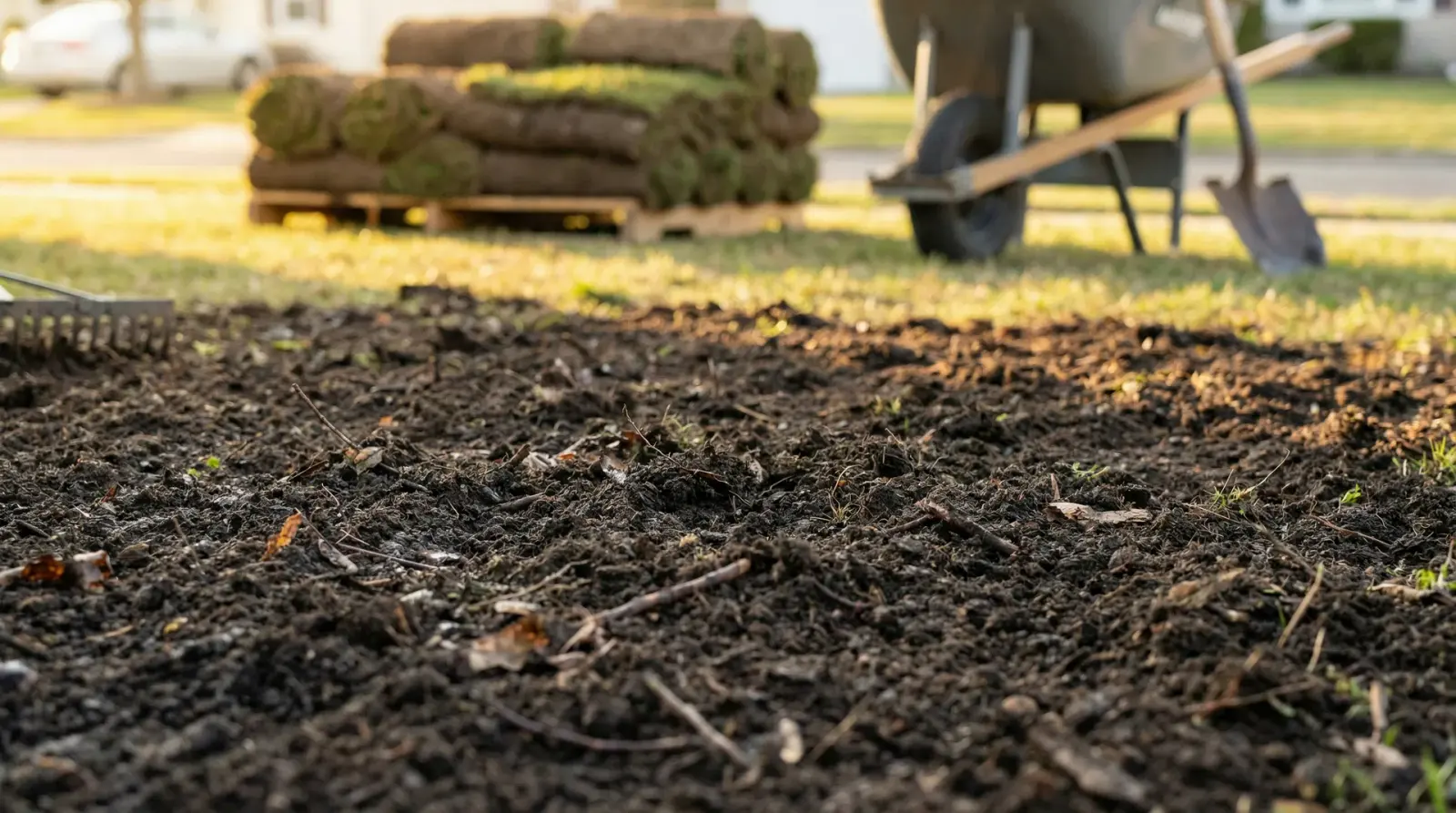
Look at the color. Dark brown or near-black means organic matter. Pale grey, orange, or yellow means subsoil — mineral dirt from below the fertile layer, often exactly what got scraped off a development site.
Smell it. Good soil smells earthy and sweet. Sour, chemical, or swampy smells mean anaerobic conditions or contamination.
Look for what should not be there. Rocks, roots, chunks of construction debris, and — the big one — weed seed. Cheap unscreened topsoil is the most common way people import a decade of weed problems into a clean yard.
Ask where it came from. A supplier who can answer plainly is a good sign. A supplier who cannot, or will not, is telling you something.
The mistakes that cost the most
Buying by price per yard alone. Topsoil ranges widely, and the cheap end is usually cheap because it is screened subsoil with no organic matter, or because it is full of weed seed. You pay the difference back in fertilizer, water, and weeding for years.
Assuming screened means good. Screening removes rocks and debris. It says nothing about fertility, organic content, or weed seed. Screened subsoil is still subsoil.
Adding sand to clay. Widely repeated, genuinely wrong. Sand mixed into clay in the wrong ratio behaves closer to concrete. If your soil is heavy, the answer is compost, not sand.
Laying a thin skim over compacted ground. Two inches of good soil over hard-packed subsoil creates a shallow perched layer. Roots fill it, hit the hard pan, and stop. The lawn then behaves as if it has two inches of soil, because it does. Loosen what is underneath before you add anything on top.
Not testing pH. Grass wants roughly 6.0 to 7.0. Monmouth County soils vary a lot across the county and often run acidic. A soil test costs very little and tells you what you are actually working with instead of what you assume.
How much do you need
For establishing a lawn, you want four to six inches of quality soil in the root zone. Less than four and you are limiting root depth permanently.
The arithmetic: length by width by depth in feet, divided by 27, gives cubic yards. A 1,000 square foot area at four inches deep is about 12.3 cubic yards. Order roughly 10% over — soil settles, and running short mid-job is worse than a small surplus.
Why we grow our own soil
Most sod companies buy soil from whoever is cheapest that week, which means the base under your lawn is a different product every job.
We grow and blend our own composted soil the same way we hold our grass to the Sod Squad Standard. It is not a marketing line — it is the reason our installs hold up. The grass is the visible part and the part everyone asks about, but the soil underneath is what determines whether the lawn is thriving in year three or thinning out and getting fed constantly to stay even.
On a sod install specifically, the base is the whole job. Sod laid on poor soil roots slowly, stays shallow, and never becomes self-sufficient. Sod laid on properly prepared soil knits in within a few weeks and then largely takes care of itself. Same sod, same crew, same day — completely different lawn a year later.
The bottom line
- Want: dark, crumbly loam with real organic matter, no debris, no weed seed, and a supplier who can tell you its origin.
- Avoid: pale subsoil, anything that smells wrong, unscreened fill, and price-shopping on soil alone.
- Depth: four to six inches, over ground that has been loosened first.
- Never: add sand to clay.
If you are about to have soil delivered and you are not sure what is on the truck, it is worth a look before it gets spread. Once it is down and sod is over it, fixing it means starting again.